


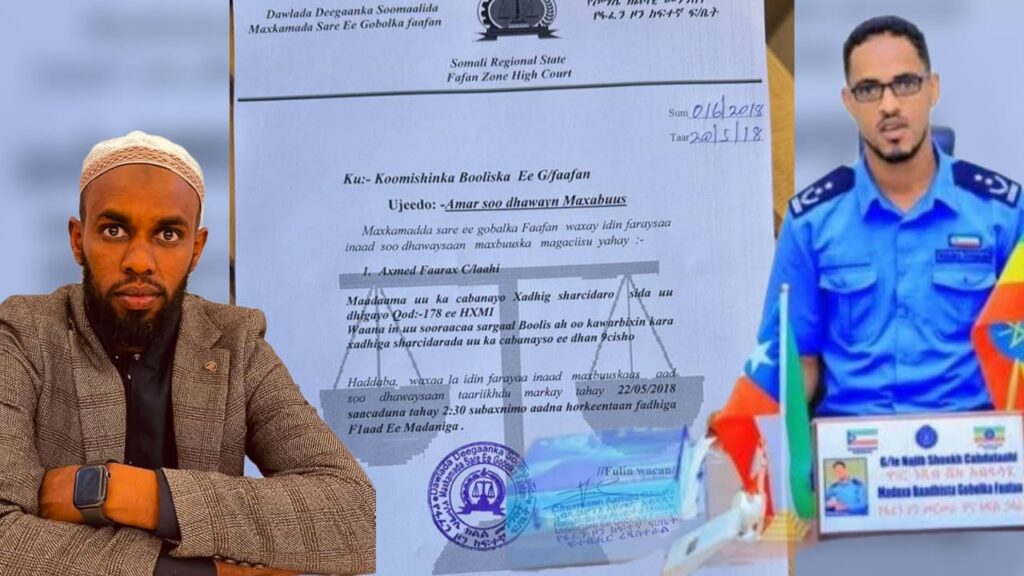
A troubling case of alleged judicial manipulation has emerged from the Faafan Zone (Gobolka Faafan) in Ethiopia’s Somali Region. The Fafan Zone Court has sentenced Ahmed Farah Abdillahi (Axmed Faarax Cabdillaahi) to two years and six months in prison—a verdict that local observers say raises serious questions about the rule of law and the influence of powerful regional figures as per karamara TV reported.
The Case and the Accusations
Ahmed Farah Abdillahi operated a printing press in Kebri Beyah (Qabribayax), a city and woreda in the Faafan Zone. He was one of several printers contracted to produce national identity cards—known as “Fayda ID”—for the local administration and surrounding rural communities. Under a formal agreement between the Kebri Beyah administration and Ahmed’s printing business, the administration would supply the necessary data, and Ahmed’s press would print the cards.
The Arrest and Investigation
Approximately four months ago, the Faafan Zone investigator, a man named Najiib, visited Kebri Beyah. According to the report, Najiib is a relative (ilmo-adeer, or cousin) of the commander of the Somali Regional State forces (DDS), General Gafaydhe. Najiib, described as someone who has caused significant hardship for local residents, took Ahmed to Jigjiga and accused him of printing forged ID cards.
The ID cards in question were sent to Telega for verification, where they were confirmed to be authentic and not counterfeit. Despite this, Ahmed remained in detention for some time.
A Pattern of Arrest and Release
Ahmed’s family filed a case with the court. When the court summoned Najiib, he promptly released the detainee and told the court he had already released him and had no further issues with him. However, a month later, Najiib summoned Ahmed again and had him rearrested. The court once again ordered his release on bail. Undeterred, Najiib apprehended Ahmed a third time and demanded that he be prosecuted.
The Trial and Dubious Witnesses
During the court proceedings, two young men were brought forward as witnesses. However, after being sworn in, each testified that they had been brought to court under coercion and threatened with fabricated charges if they did not provide false testimony. They further stated that they had no knowledge of the defendant or any wrongdoing on his part.
Additionally, representatives from the Kebri Beyah administration appeared before the court and confirmed that the IDs printed by Ahmed were legitimate and that they had a valid agreement with his printing press. Their testimony, however, was reportedly disregarded.
The Verdict and Its Implications
Ultimately, Ahmed Farah Abdillahi was sentenced to two years and six months in prison, apparently based solely on the wishes of investigator Najiib. The case has drawn attention to the broader issue of how the judicial system operates in the region, with local residents reportedly well aware of the influence wielded by individuals connected to regional leaders and military commanders.
Broader Context
This case unfolds against a backdrop of ongoing tensions and reported abuses in the Somali Region. General Gafaydhe, identified as the regional police commander, has been previously implicated in other incidents, including a large-scale operation in the Da’awaley area of the Xarshin district that reportedly left dozens of civilians dead and thousands displaced. Such incidents have raised broader concerns about governance, the impartiality of regional forces, and the protection of civilian rights in the region.
Conclusion
The sentencing of Ahmed Farah Abdillahi, as reported by Karamara TV, highlights ongoing concerns about judicial independence and the influence of regional power structures in Ethiopia’s Somali Region. With the court appearing to ignore evidence of the IDs’ authenticity, testimony from the local administration confirming the validity of the contracts, and witnesses recanting under duress, the case raises troubling questions about due process and the rule of law. Neither the Faafan Zone administration nor the Somali regional government has issued an official response to the allegations at the time of this reporting.