

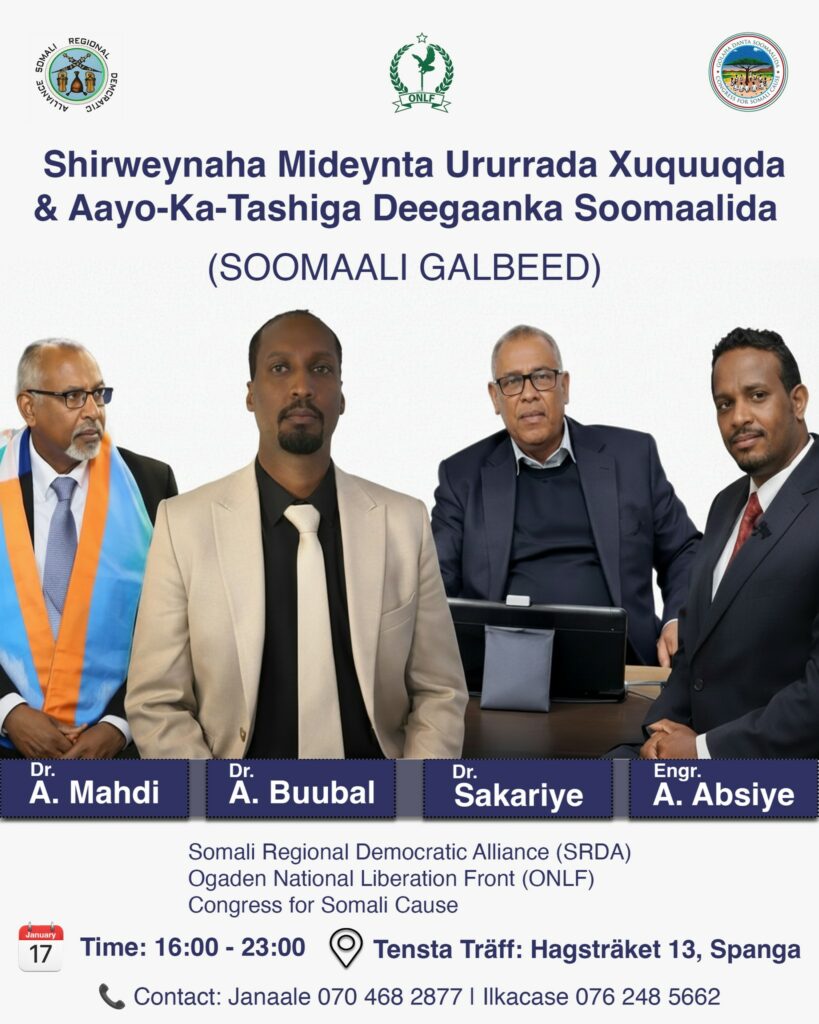
History Opens a Narrow but Powerful Window for the Somali People
History has once again opened a narrow yet consequential window—an opportunity through which the Somali people can advance their long-standing aspirations by uniting around a clear vision, genuine solidarity, and a principled struggle. This opportunity was not granted by those in power; rather, it emerged from profound political miscalculations by the current Ethiopian government led by Prime Minister Abiy Ahmed and segments of the Oromo political elite, aided by Somali actors embedded within the system.
The Erosion of Federal and Somali Rights
In recent years, the constitutional guarantees that once offered hope to the Somali people have been systematically dismantled. These include:
- The right to form and operate political parties
- The right of communities to defend themselves
- Access to education, employment, and public institutions
- Fair participation in the management of natural resources
- Protection of Somali land, people, and identity
Instead of progress, there has been regression.
Instead of federalism, centralization.
Instead of inclusion, repression has become state policy.
Four Missed Historical Opportunities
This moment represents the fourth missed opportunity in Somali history to resolve their destiny peacefully:
- 1945–1958: The transfer of Somali-inhabited territories without the consent of the people
- 1977: A local liberation struggle transformed into a state-to-state war
- 1991: The promise of federalism that failed to deliver genuine self-rule
- 2018: A reform moment that raised hope but ended in betrayal
Each time, the Somali people chose patience and peace.
Each time, that patience was repaid with injustice.
Why Has Failure Repeated Itself?
Three fundamental reasons explain this recurring failure:
1. A Political Elite Detached from Its People
Sections of the Somali political leadership lost confidence in their own people and became instruments of external interests. Today, much of the Somali regional leadership owes its loyalty not to the public, but to the ruling party in Addis Ababa. They are permitted to administer poverty and basic services while corruption flourishes.
2. Persistent Misunderstanding of the Somali Cause
Ethiopia’s broader political class has consistently underestimated or misunderstood Somali history, struggle, and aspirations—an error reinforced by Somali elites who prioritized personal survival over collective rights.
3. Structural Contradictions Within the Ethiopian State
Ethiopia’s political landscape is fractured. Oromo, Amhara, Tigrayan, and other elites lack a shared national vision. What unites them is an ambition for territorial expansion and access to the sea—often pursued at the expense of Somali rights and stability.
The End of the 2018 Illusion
In 2018, the Somali people made a courageous choice for peace. Arms were laid down, dialogue was embraced, and unprecedented trust was extended to a government with a long record of bad faith.
That chapter is now closed.
Dialogue has been replaced by repression.
Reform by displacement.
Federalism by force.
This is not mere misgovernance—it is a deliberate strategy.
The Geopolitical Reality Facing the Somali People
Somalis live across artificial borders that ignore deep cultural, social, and historical ties. Any policy that dismisses this reality threatens regional stability in the Horn of Africa.
Over the past eight years:
- Nearly 30 percent of Somali land has been lost through administrative and military measures
- Entire communities have been forcibly displaced
- Displaced populations from Garba Issa, Balabality, Cundhufo, and Aydhauty have been barred from returning home
- Armed groups among other ethnic communities have been tolerated or encouraged, while Somali communities are deliberately left unprotected
Conclusion: A Call for Unity and Resolve
Let this be stated clearly: the era of unproductive dialogue has ended—not by our choice, but by the actions of the ruling system.
An existential threat now confronts the Somali people, yet they are not broken. Few nations have demonstrated patience comparable to that of the Somali people.
Today, the call is unmistakable:
- Unity around a shared vision and destiny
- Strengthened political coordination
- Collective resistance to injustice and renewed domination
Victory is not a matter of chance.
Victory is a matter of decision.
And the decision of the Somali people is unbreakable.