

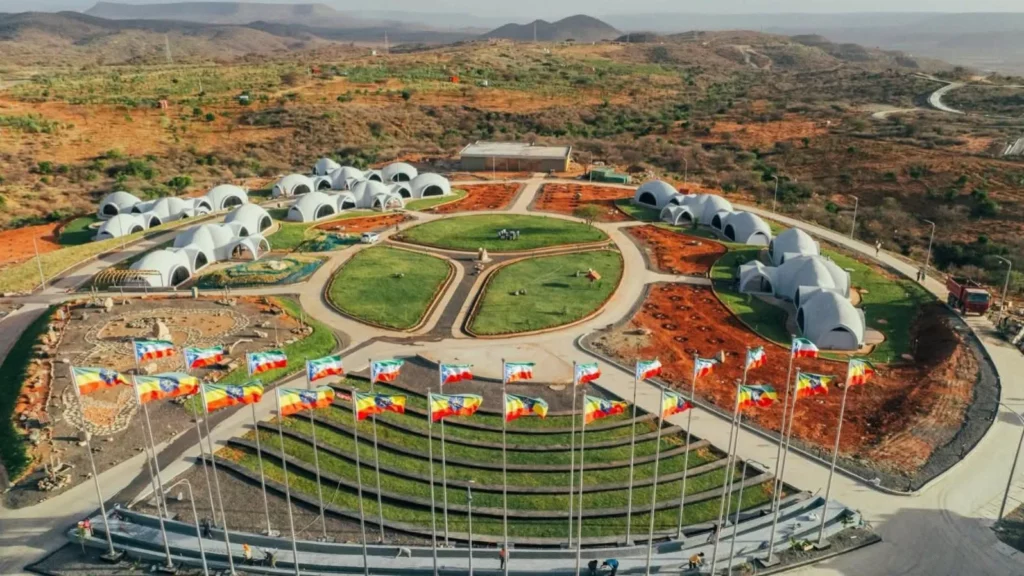
JIGJIGA, Somali Region – In a high-profile display of regional recalibration, Ethiopian Prime Minister Abiy Ahmed hosted Somalia’s President Hassan Sheikh Mohamud and Djibouti’s President Ismail Omar Guelleh on Saturday, January 31, 2026, for the dual inauguration of the Shabeely Resort and the Aysha-II Wind Power Project.
The event, held in the Sitti Zone of Ethiopia’s Somali Regional State, served as a landmark moment for the “Dine for Generations” initiative. However, the conspicuous absence of Somaliland’s newly elected President, Abdirahman Mohamed Abdullahi (Irro), provided a sharp reminder of the complex diplomatic fault lines still beneath the surface of the Horn of Africa’s “cooperation” narrative.
A Twin Milestone: Energy and Tourism Integration
The day’s proceedings underscored Ethiopia’s strategy of using massive infrastructure to bind neighboring economies.
- The Shabeely Resort: Spanning 385 hectares, the resort is a flagship of PM Abiy’s “Dine for Generations” program. Designed to transform the Somali Region into a premier tourism hub, it features world-class hospitality facilities, including three restaurants and a 10,000-tree fruit park.
- Aysha-II Wind Power: Beyond tourism, the leaders inaugurated the first phase of the 120 MW Aysha-II Wind Power Project. Built by China’s Dongfang Electric Corporation, the project is strategically located near the Djibouti border, intended to facilitate cross-border energy trade and stabilize the regional grid.
In his keynote address, Prime Minister Abiy emphasized “Medemer” (synergy), stating that the prosperity of the Horn is “indivisible.” President Hassan Sheikh Mohamud echoed these sentiments, signaling a stabilization of Mogadishu-Addis Ababa ties following months of tension over port access.
The Somaliland Equation: Absence and Recognition
While the leaders of the recognized “Big Three” nations showcased unity, the leadership of Somaliland was noticeably absent. The absence of President Irro was not a mere diplomatic snub but a reflection of a dramatic shift in his administration’s foreign policy priorities.
At the time of the inauguration, President Irro was in the United Arab Emirates for the 2026 World Governments Summit in Dubai. His visit to the UAE—his fourth since taking office in late 2024—follows the seismic diplomatic event of December 26, 2025: Israel’s formal recognition of Somaliland as an independent state.
“Somaliland’s presence at global forums like the World Governments Summit signals that we are no longer a ‘breakaway region’ but a strategic partner on the global stage,” a senior Somaliland official stated.
The Israeli recognition, which included a pledge for Somaliland to join the Abraham Accords, has effectively shifted Hargeisa’s focus away from local regional ceremonies and toward institutionalizing its new status with major global powers.
Diplomatic Realignment and Challenges
The “Jigjiga Summit” highlights a region in flux:
- Consolidation of Sovereignty: By attending, President Hassan Sheikh Mohamud reaffirmed Somalia’s role as the primary diplomatic partner for Ethiopia, countering the influence of the 2024 Ethiopia-Somaliland MoU.
- Red Sea Geopolitics: Israel’s recognition of Somaliland has introduced a new “Red Sea Axis,” involving security cooperation to counter Houthi threats, which has drawn condemnation from Mogadishu, the Arab League, and the African Union.
- Economic Pragmatism: Despite the political friction, the Aysha-II project demonstrates that energy and infrastructure needs—particularly for landlocked Ethiopia and transit-critical Djibouti—remain the strongest drivers of regional stability.
Looking Ahead
The Shabeely Resort and Aysha-II project are physical testaments to a more integrated Horn of Africa. Yet, as the leaders of Ethiopia, Somalia, and Djibouti shared the stage in Jigjiga, the shadow of Somaliland’s burgeoning international legitimacy loomed large.
For the regional governments, the challenge for 2026 remains clear: balancing the tangible benefits of economic integration with the increasingly complex reality of a changing diplomatic map.