

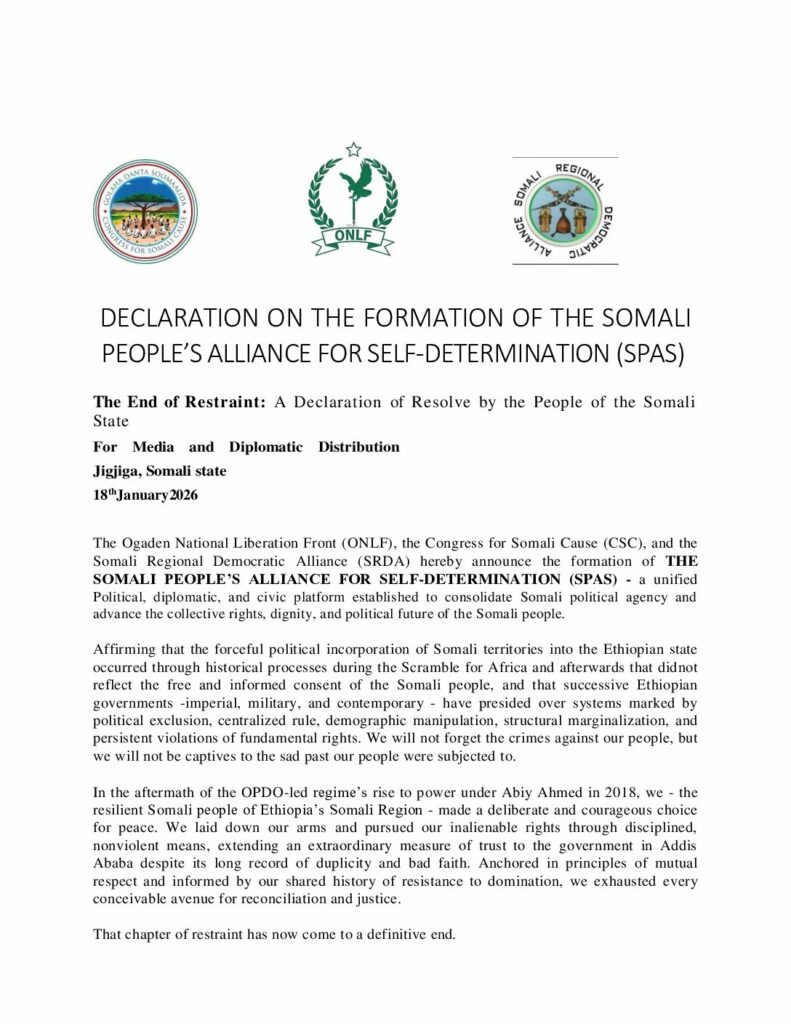
A historic political realignment has taken shape. Somali political forces have formally announced the creation of the Somali People’s Alliance for Self-Determination, a unified front established by the Ogaden National Liberation Front (ONLF), the Congress for the Somali Cause, and the Somali Rights and Development Association (SRDA).
This alliance marks a decisive shift in the Somali struggle—from fragmentation and reactive politics toward unity, coordination, and a renewed, principled political struggle. It reflects a collective conclusion that decades of patience, dialogue, and unilateral concessions have failed to secure Somali rights within the Ethiopian federal system.
The Alliance was formed in response to the continued erosion of constitutional guarantees, the dispossession of Somali land, the marginalization of Somali communities from federal institutions, and the collapse of the reform promises made in 2018. Its core objective is to unify Somali political parties, civic movements, and liberation forces under a shared vision of self-determination, justice, and democratic rights—while working in solidarity with other Ethiopian political actors seeking an end to authoritarian governance and a genuine federal order based on equality and consent.
This is not a symbolic gesture. It is a strategic political response to a deepening crisis.
Right Time to Unify Somali Political Parties for a Renewed Struggle
History rarely offers second chances. When it does, the moment is narrow, unforgiving, and demands clarity of purpose and unity of action. Today, the Somali people stand once again at such a crossroads. This opportunity was not granted by those in power; it emerged from profound political miscalculations by the current Ethiopian government under Prime Minister Abiy Ahmed and from the continued marginalization of Somali voices within the federal system.
For decades, Somalis chose patience over confrontation and dialogue over violence. That choice was principled. Yet patience has been repaid with dispossession, exclusion, and repression.
The Collapse of Federal Promises
The federal constitution once promised equality, self-rule, and protection. In reality, Somali communities have experienced:
- The steady erosion of political freedoms
- Systematic exclusion from federal security and decision-making institutions
- Loss of land and forced displacement
- Marginalization in economic planning and resource governance
What was promised as federalism has been replaced by centralization. What was described as reform has become control.
Why Unity Has Become a Necessity
This moment represents the fourth major historical failure to resolve the Somali question peacefully—after 1945–58, 1977, 1991, and 2018. Each time, Somali restraint was misread as weakness. Fragmentation within Somali politics made that failure easier.
The formation of the Somali People’s Alliance for Self-Determination directly addresses this weakness. It recognizes that no single party, organization, or region can carry this struggle alone. Unity is no longer an option—it is a condition for survival.
A Coordinated Political Struggle
The Alliance seeks to:
- Coordinate Somali political action across regions and the diaspora
- Defend Somali land, identity, and political rights
- Restore genuine federalism grounded in consent and equality
- Engage constructively with other Ethiopian democratic forces to bring about systemic political change
This is a call for organized, principled political struggle, not chaos or disorder.
Conclusion: A Moment That Demands Decision
The era of fragmented politics and unproductive dialogue has ended—not by Somali choice, but by the actions of the ruling system.
Victory is not a matter of chance.
It is a matter of decision.
And when the Somali people decide together—clearly, peacefully, and with resolve—their voice cannot be ignored.
The time to unite is now.